|
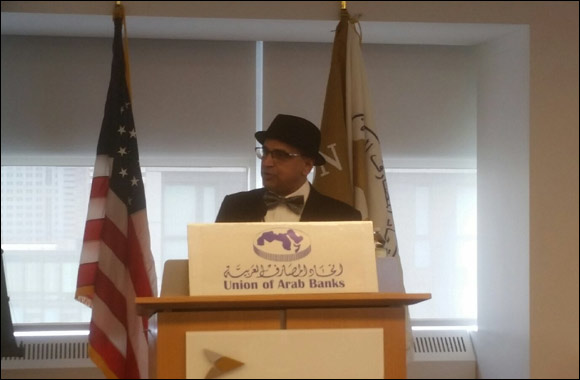
Dubai, October 16, 2014: Banks should strengthen their fight against financial crime to protect against reputation risks, said Dr. R. Seetharaman, Group CEO, Doha Bank at the fifth US- MENA Private Sector Dialogue on correspondent banking, which was hosted by the Union of Arab Banks at BNY Mellon, New York on 14th and 15th October 2014. Dr. Seetharaman participated in the session on the topic “Customer risk ratings and evolving nature of financial crime” on 15th October 2014. The speakers in this event included Mr. Thomas C. Baxter, Executive Vice President and General Counsel, Federal Reserve Bank of New York, Mr. Alberto Musalem Borrero, Executive Vice President, Federal Reserve Bank of New York, Mr. Sean O’Malley, Deputy Chief Investigator & Vice President- Enforcement Division, Federal Reserve Bank of New York and Mr. Sarkis Yoghourtdjian, Assistant director - Board of Governors, Federal Reserve System, Washington. Speaking at the conference Dr. Seetharaman gave insights on current trends in Correspondent Banking. He said, “Banks have looked forward to scale their vast Correspondent Banking networks to reduce risks and strengthen controls, expand their client coverage and geographic reach by striking up new banking partnerships. However with the onslaught of new financial regulation banks need to reassess and redefine this business. With banking revenues under pressure, many banks are questioning whether they can continue to try to offer all services to clients in all markets, combined with rising costs related to new regulations. Banks are selectively increasing the global banking partnerships.” Dr. Seetharaman highlighted the importance of correspondent banking in the Middle East. He said “After crisis, letters of credit re-emerged as the key solution for alleviating the spike in credit risk concerns. During the financial crisis, it was correspondent banking, which played a pivotal role as many global banks retreated towards their home market, leaving constraints in trade funding and risk mitigation. Local banks became vital, both for local corporates and their international trading partners. When it came to securing the handling of trade flows despite a spike in perceived risks during the crisis, local banks proved that their knowledge of local companies was critical to keep trades flowing.” Dr. Seetharaman gave insights on regulatory focus on correspondent banking. He said “Regulators continue to scrutinise due diligence and risk management practices in the Correspondent Banking arena due to the inherent risks associated with processing transactions as well as cases in which Correspondent Banking accounts have been used to move illicit funds. Recent regulatory actions have resulted in record-breaking financial penalties and have highlighted the vulnerabilities which financial institutions are exposed to when there are failures in in the areas of governance, client due diligence, risk assessment and transaction monitoring.“ Dr. Seetharaman highlighted the recent Financial Crimes, and AML lawsuits faced by financial institutions. He said, “Certain banks failed to conduct basic due diligence on some of its account holders, assign the appropriate risk categories and ignored warnings that monitoring systems are not adequate. Violation of Know Your Customer (KYC) norms also exposed them to fraud risks. Certain banks failed to check and monitor the relationships its corporate customers had with politically exposed people. Some banks failed to identify high risk transactions. Financial crimes have increased the penalties for banks and also affected the reputation risks.” Dr. Seetharaman gave insights on areas to focus in an AML program. He said “In order to be successful, AML initiatives cannot be left to business as usual. Senior management must sponsor AML with remediation being driven by governance, structure and process, and with all changes being managed by a dedicated capability. The key areas to focus include new account opening procedures, sustained customer identification process, customer risk rating, enhanced due diligence and transaction monitoring and reporting. As cyber crime getting more sophisticated, the onus is on banks and financial institutions to be extra vigilant on web based transactions. Globalisation is breaking down of barriers with regard to exchange control and more sophisticated avenues of investments like derivatives and mutual funds, tracking suspicious transactions is bound to become more challenging, bankers need to be more diligent and vigilant.” The financial crimes has emerged as one of the major risks affecting the reputation of financial services industry in recent times hence banks need to strengthen their fight against financial crimes to protect against reputation risks.
|


 RSS Feed