
Doha – October 26, 2026: Thirty-two second-year medical students from Weill Cornell Medicine-Qatar (WCM-Q) completed biomedical summer research projects at elite international institutions in Qatar, the US and the UK.
The projects are part of the college's Advanced Biomedical Sciences Research (ABSR) elective course, which offers students who have completed the first year of the medical curriculum the opportunity to pursue a personal scholarly experience in biomedical science. The elective is open to students who wish to graduate with honors in research or who otherwise are interested in developing their scientific investigation and clinical research skills.
This student-initiated program invites students to submit research proposals for consideration, develop working relationships with prospective mentors and secure invitations to visit and collaborate on research projects. The program, which lasts eight weeks, offers a variety of experiences, including clinical research, laboratory research, social science projects, public health projects and other translational projects.
The majority of this year's cohort of participating students were awarded the Medical Student Research Award (MSRA), which is provided by the WCM-Q Research Division, to support their travel.
The students spent the summer working on research projects in the areas of orthopedics, neurology, oncology, hematology, immunology and endocrinology, among others, with placements at specialized centers at Weill Cornell Medicine in New York, NewYork-Presbyterian, University of Oxford and WCM-Q.
Student Abdulla Al-Mutawa spent the summer at Weill Cornell Medicine in New York in the laboratory of Dr. Shahin Rafii, founding director of the Hartman Institute for Therapeutic Organ Regeneration, the Arthur B. Belfer Professor of Genetic Medicine, chief of the Division of Regenerative Medicine in the Department of Medicine and director of the Ansary Stem Cell Institute, learning how to preserve the diverse phenotype of mesenchymal stromal cells through modulation of TGF-β signaling.
Abdulla said: "Participating in the ABSR this summer gave me the opportunity to explore my interests beyond the lecture hall and experience research in a completely new environment. At the Ansary Stem Cell Institute at WCM-NY, I strengthened my laboratory and research skills while gaining valuable exposure to translational stem cell research. I would encourage future students to take advantage of ABSR as an opportunity to challenge themselves, discover new interests, and see how research can shape their future careers as physicians."
Student Luai Hommos joined Dr. Mootaz Salman, associate professor of neurobiology, in his lab at the University of Oxford to investigate blood-brain barrier (BBB) integrity in mouse models of induced synucleinopathy. Parkinson's disease and other synucleinopathies are increasingly linked to early breakdown of the BBB, which may serve as a diagnostic marker before clinical symptoms appear. Hommos also spent the summer working on a project modeling ischemic stroke through hypoxia-driven BBB dysfunction in microfluidic chips.".
Hommos said: "This experience deepened my understanding of how in vitro and in vivo models can complement one another in neurovascular research and reinforced how fundamental research into disease mechanisms, like BBB dysfunction in neurodegeneration, can inform earlier diagnostic strategies and, ultimately, patient care."
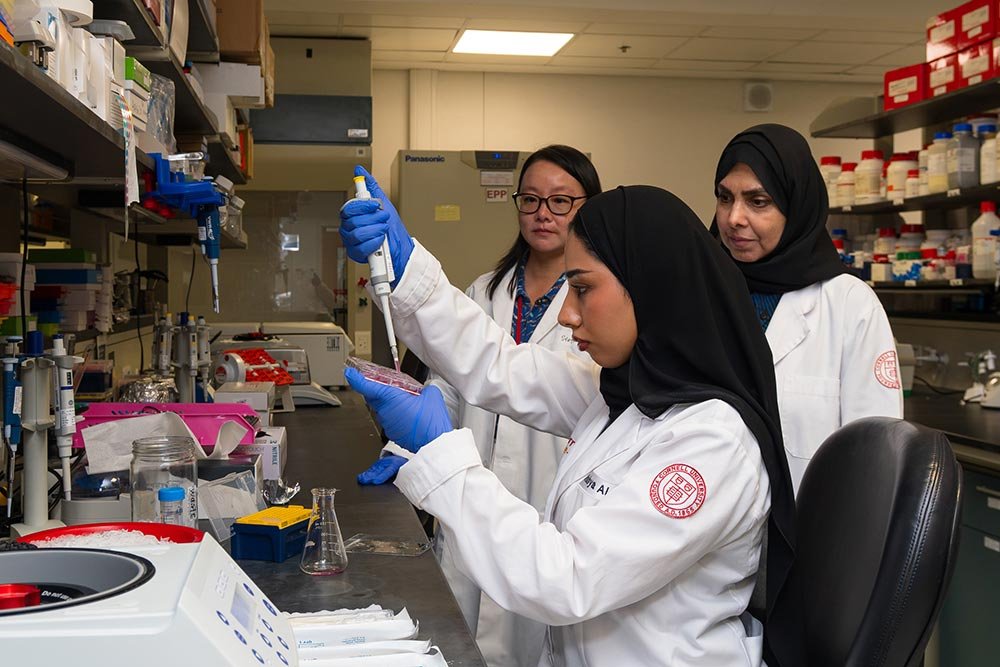
Student Dhabya Al-Naimi, who completed her project under the supervision of Dr. Joel Malek, associate professor of genetic medicine at WCM-Q, said: "I would say that the MSRA and ABSR experience is valuable for any medical student because, beyond learning about diseases and treatments that have already been discovered, it allows us to understand how those discoveries actually came to be. Working in the lab and experiencing the constant trial and error, troubleshooting and problem-solving taught me persistence and how to approach challenges from different perspectives. I also really valued being able to have this experience in Doha, as Weill Cornell Medicine-Qatar provides a great research environment, and I was able to gain the full research experience while also spending my summer at home."
Dr. Nayef Mazloum, associate professor of microbiology and immunology, and associate dean for student research at WCM-Q, said: "Our ABSR elective is an intensive research program designed to help students with research interests further develop that passion through access to leading experts at some of the best laboratories in the world. This year's cohort of students has shown a consistent commitment to strengthening their research skills, and I am extremely proud of everything they have achieved over the summer. I would like to sincerely thank this year's mentors for generously giving their time to share their scientific expertise with our enthusiastic students and for playing such an important role in their research experience."